
 Blog
Indian Philosophy Explained: From the Vedas to Moksha, and What It Means for Your Kundli
A complete, simple guide to Indian philosophy: the Vedas and Upanishads, the six darshanas, astika and nastika, Advaita and the Vedanta acharyas, and the three kinds of karma, with how Vedic astrology reads each one in your kundli.
You may say you have no philosophy. Yet if you believe that every action returns to you, that something in you continues after the body falls, or that a difficult phase of life is "the fruit of past karma", you are already speaking the language of Indian philosophy. Most of us live by these ideas every day. We simply never learnt where they came from, who argued for them, and why they still shape the way an Indian family reads a birth, a marriage or a misfortune.
This guide is that map. It walks through the whole of Bharatiya Darshan, from the Vedas and Upanishads to the six classical schools, the great Vedanta acharyas, the bhakti saints and the modern thinkers. Then it shows why all of this matters to anyone who looks at a kundli, because Vedic astrology stands on exactly these ideas: karma, rebirth, the soul and moksha.
Key takeaways
- Darshan means "seeing": Indian philosophy was always meant to change how you see and live, not only how you argue.
- Astika and nastika are not "believer and atheist". The test is acceptance of the Vedas, not belief in God.
- The Upanishads, the closing part of the Vedas, already contain atman, Brahman, karma, rebirth and moksha.
- The six darshanas (Shad Darshana) work in three pairs and together form what is called Hindu or Sanatan philosophy.
- Karma theory divides karma into sanchita, prarabdha and kriyamana, and Jyotish reads each one in a different part of the chart.
- Indian philosophy begins with suffering but ends with freedom from it, which makes it realistic, not pessimistic.
Why begin with Indian philosophy?
There are two broad ways to study philosophy: start with the West, or start at home. At AstroAnsh we begin at home, for three reasons.
It is ours. Before studying anyone else's map of life, it makes sense to know the one our grandparents lived by, often without naming it.
It is among the oldest. The first philosophers of Greece, beginning with Thales, belong to the sixth century BCE. By then India already had the Vedas, a long tradition of Upanishadic inquiry, and teachers such as Mahavira and the Buddha who were reshaping that inquiry. Indian philosophy is one of the oldest continuous philosophical traditions in the world.
It is hard to find in one place. Western philosophy has many simple introductions that tell its story from beginning to end. Indian darshan is usually scattered across heavy academic textbooks. This article tries to put the whole picture on a single page, in plain language, so that you can see how each idea leads to the next.
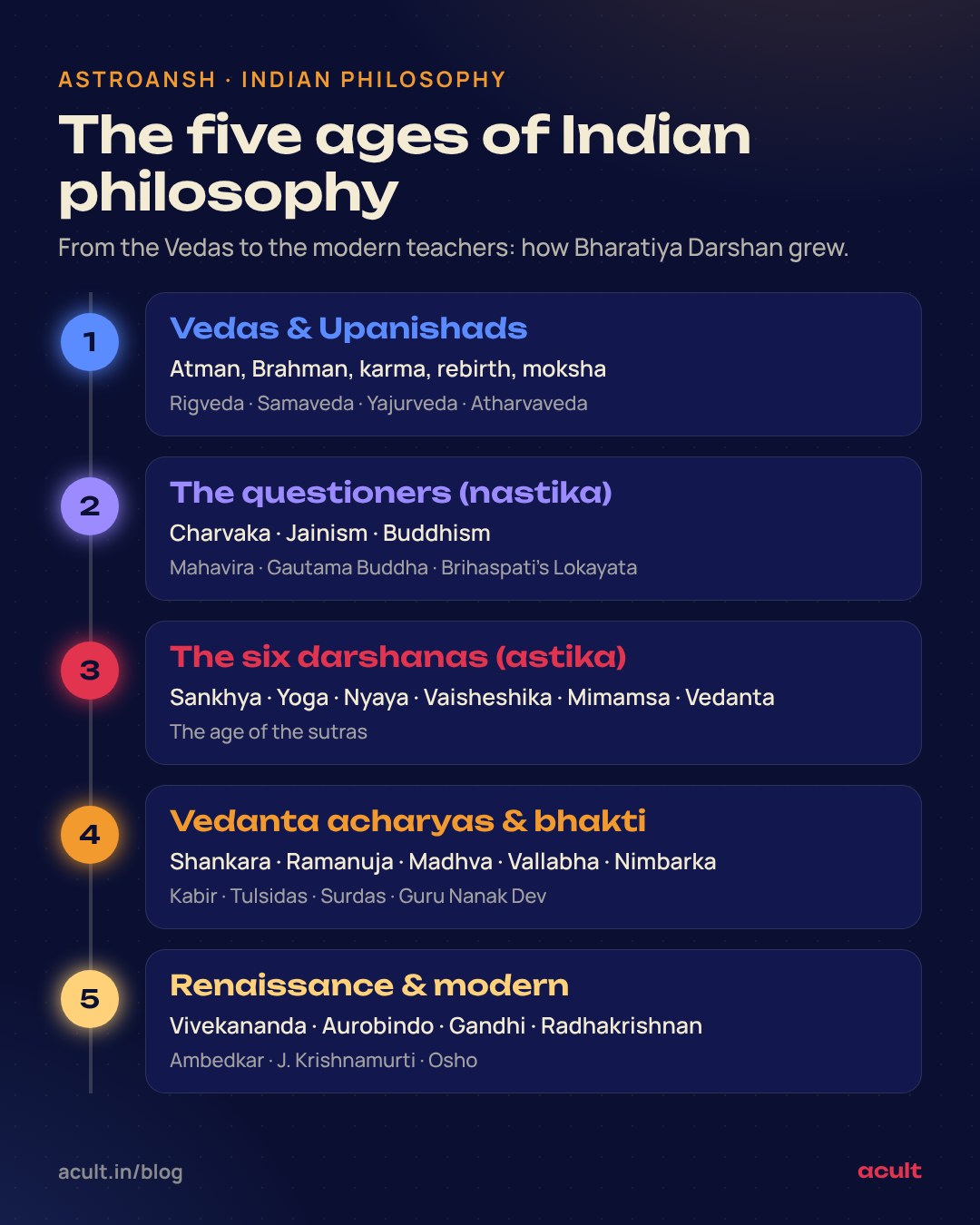
The first age: the Vedas and the Upanishads
The four Vedas
The four Vedas are the Rigveda, Samaveda, Yajurveda and Atharvaveda. Tradition holds that they are not the work of one author. They are the hymns, chants and insights of many rishis, composed and remembered over a long span of time, and later arranged into four collections. That great work of arrangement is credited to Maharshi Ved Vyasa, who is also remembered for the Mahabharata (with the Bhagavad Gita inside it) and the eighteen Puranas. Some teachers, including Swami Vivekananda, suggested that "Vyasa" may be the name of a lineage rather than a single person, given how vast the work is.
The schools themselves disagreed about where the Vedas came from. Nyaya held that they were composed by God. Mimamsa, which did not need a creator God, held that the Vedas are apaurusheya: not made by any person, human or divine, but eternal, and only heard and passed on by the rishis.
The four layers of every Veda
Each Veda has four layers, and knowing them explains a great deal about how Indian thought developed:
| Layer | What it contains | Who it speaks to |
|---|---|---|
| Samhita | the mantras and hymns themselves | the worshipper |
| Brahmana | the rules, procedures and meaning of the rituals | the priest conducting the yajna |
| Aranyaka | teachings for those who withdrew to the forest | the renunciant |
| Upanishad | philosophical inquiry into the self and reality | the seeker |
Notice the movement. The Veda begins with outer worship, moves to the rules of ritual, then to the inner life of the forest-dweller, and ends with pure inquiry. Indian philosophy was born inside this journey from the outer to the inner.
One truth, many names
The early hymns praise many devatas: Agni, Indra, Varuna, Surya, Soma. Some hymns even ask, again and again, kasmai devaya havisha vidhema: "to which god shall we offer our worship?" Yet very early the rishis saw past the many names to one reality:
एकं सद्विप्रा बहुधा वदन्ति
Ekaṁ sad viprā bahudhā vadanti
Truth is one; the wise call it by many names. (Rigveda 1.164.46)
This single line resolves the confusion of the many gods, and it shaped Indian religious life ever after: many paths, one truth.
The Upanishads: the heart of Vedanta
Because the Upanishads come at the end of the Vedas, they are called Vedanta, literally "the end of the Veda". Tradition counts 108 Upanishads, of which ten to twelve are considered principal. The Brihadaranyaka (connected with the Yajurveda) and the Chandogya (connected with the Samaveda) are generally regarded as the oldest. Others studied closely include the Isha, Kena, Katha, Mundaka, Mandukya and Shvetashvatara.
Almost every idea that Indians still live by is already clear in the Upanishads:
- Atman: the self, which is more than body and mind
- Brahman: the one reality behind everything
- Karma and punarjanma (rebirth)
- Moksha: liberation from the cycle of birth and death
The Upanishads also say that Brahman, in the end, cannot be captured in any description. Whatever you say about it, the sage replies "neti, neti": not this, not this. Centuries later, Adi Shankaracharya would build his whole philosophy on this insight.
Their great sayings, the Mahavakyas, still stop the mind:
- Aham Brahmasmi: I am Brahman (Brihadaranyaka Upanishad)
- Tat tvam asi: You are That (Chandogya Upanishad), the words written at the entrance of the Sabarimala temple in Kerala
The second age: the questioners (nastika schools)
As Vedic ritual grew heavier, and especially as large sacrifices involving animals spread, a reaction set in. Some teachers began to question not just the rituals but the authority of the Vedas themselves.
What "astika" and "nastika" really mean
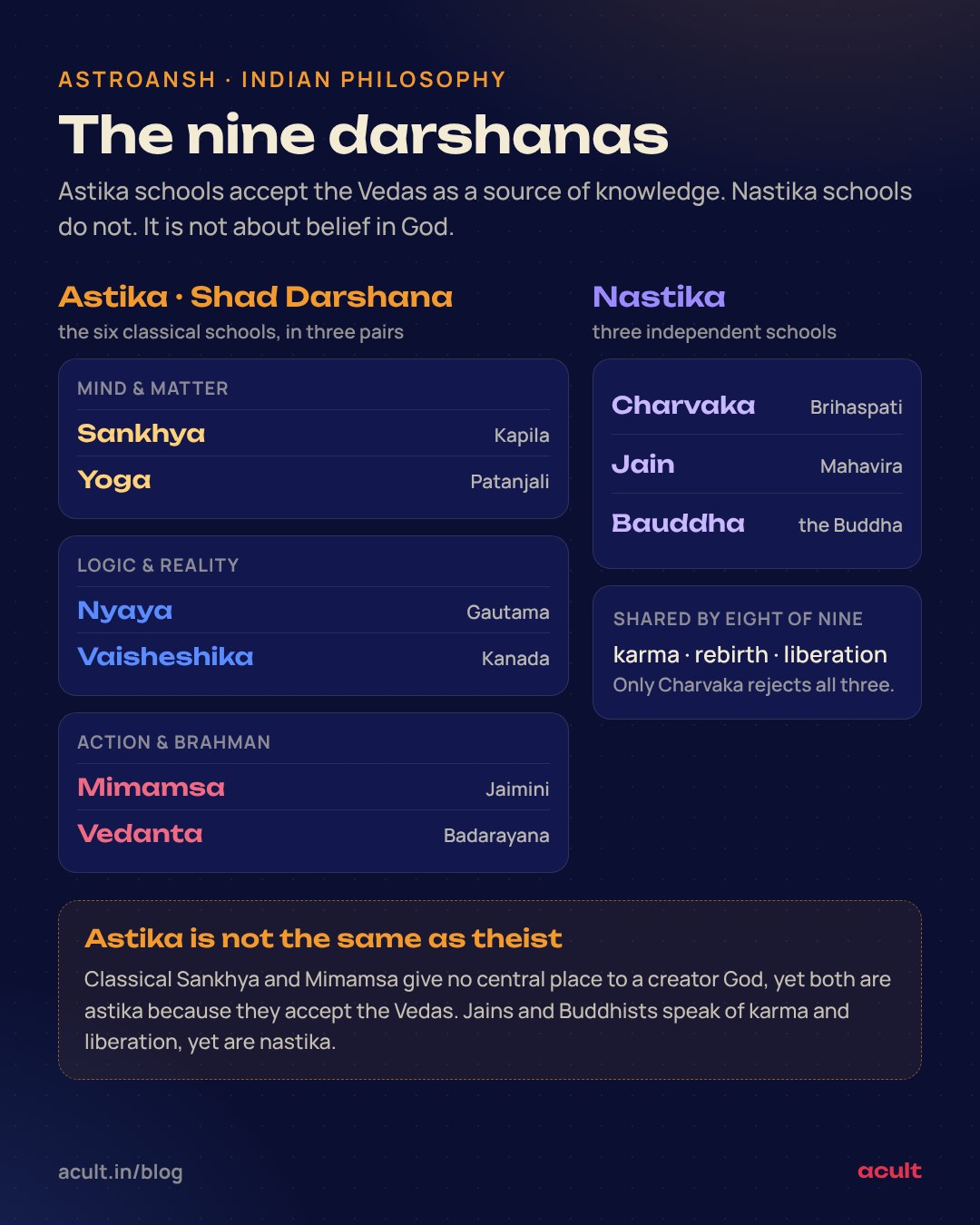
Here lies the most common misunderstanding about Indian philosophy. In everyday Hindi, astik means a believer in God and nastik an atheist. In darshan, the words mean something else. A school is astika if it accepts the Vedas as a valid source of knowledge (shabda pramana, the evidence of authoritative testimony), and nastika if it does not. As the Manusmriti puts it, nastiko vedanindakah: the nastika is one who rejects the Veda.
This is why classical Sankhya, which gives no central role to a creator God, is still astika, while Jainism and Buddhism, which speak at length about karma and liberation, are nastika.
The three nastika schools
Charvaka (Lokayata), traced to the teacher Brihaspati, is India's materialist school. It accepts only what can be perceived directly. There is no soul beyond the body, no rebirth, no heaven and no moksha; this life is all there is, so live it well. Its most famous line, pibatu pibatu punah pibatu, "drink, drink, and drink again", is often quoted against it, but Charvaka played a serious role: it forced every other school to defend its claims with evidence.
Jain darshan was given its classical form by Mahavira, the twenty-fourth and last Tirthankara of the present cycle. It teaches ahimsa (non-violence) at its strictest, anekantavada (the many-sidedness of truth) and liberation as kaivalya, the soul's freedom from karmic matter. Over time the tradition divided into Shvetambara and Digambara.
Bauddha darshan is the path of Gautama Buddha, built on the Four Noble Truths and the Eightfold Path. It later developed into the Hinayana (Theravada) and Mahayana traditions, and in the twentieth century Dr. B. R. Ambedkar founded Navayana, a rational and socially engaged Buddhism, in 1956.
The third age: the six darshanas (Shad Darshana)
The answer to the questioners was a rediscovery of the Vedas and Upanishads. Six schools re-founded philosophy on Vedic authority while each developing its own system. Together they are called the Shad Darshana, the six classical views, which is what people usually mean by Hindu philosophy or Sanatan darshan. When someone calls themselves Sanatani in the philosophical sense, they are accepting these six views as authoritative.
The six work as three pairs. In each pair one school leans more on one area of philosophy, the other on another, and each accepts the other's work:
| Pair | Founding text and teacher | Main focus |
|---|---|---|
| Sankhya | Kapila (the original Sankhya Sutra is lost; the Sankhya Karika survives) | the two principles: purusha (consciousness) and prakriti (nature) |
| Yoga | Patanjali's Yoga Sutras | the discipline that stills the mind |
| Nyaya | Akshapada Gautama's Nyaya Sutras | logic and the means of valid knowledge (epistemology) |
| Vaisheshika | Kanada's Vaisheshika Sutras | the categories of reality and the theory of atoms (metaphysics) |
| Mimamsa | Jaimini's Mimamsa Sutras | the right performance and meaning of Vedic action (dharma) |
| Vedanta | Badarayana's Brahma Sutras | the nature of Brahman, the self and liberation |
Note that Patanjali did not invent yoga: yoga is far older. His achievement was to gather it into a precise system of sutras. In the same way, Badarayana's Brahma Sutras (also called the Vedanta Sutras) organise the teaching of the Upanishads. Many in the tradition identify Badarayana with Ved Vyasa himself.
The age of the sutras
This was the age of the sutra: a short formula designed to be memorised in a time when teaching passed from mouth to ear. A sutra packs a whole argument into a line. That is its genius and its difficulty, which is why every school produced bhashyas (commentaries) and tikas (sub-commentaries) to unpack it. Much of Indian philosophy is a conversation carried on through commentaries on commentaries.
The three gunas: Sankhya's gift to astrology
Sankhya gave Indian thought an idea that every Jyotishi still uses: the three gunas. All of nature, including body and mind, is woven from three qualities:
- Sattva: clarity, calm, balance and understanding
- Rajas: drive, desire, passion and restlessness
- Tamas: heaviness, inertia, sleep and resistance
Every person carries all three; what differs is the mix. In Vedic astrology, each graha carries a guna: the Sun, Moon and Jupiter are sattvic, Mercury and Venus rajasic, and Mars, Saturn, Rahu and Ketu tamasic. This is one reason the same house reads so differently under the Moon and under Saturn.
The fourth age: the great Vedanta acharyas and the bhakti movement
From roughly the eighth century onwards, the most creative work in Indian philosophy happened inside Vedanta. Every Vedanta teacher had to explain three texts together, the Prasthana Trayi or "three starting points":
- the principal Upanishads
- the Bhagavad Gita, the most widely read of the three, written in clear and simple Sanskrit
- the Brahma Sutras
Their different readings of these three texts created the great schools of Vedanta.
Adi Shankaracharya and Advaita Vedanta
Adi Shankaracharya lived only thirty-two years, yet his Advaita Vedanta (non-dualism) remains one of the deepest systems of thought anywhere. Its teaching in one line: only Brahman is ultimately real; the individual self is not different from Brahman; and the world is mithya.
Mithya is often translated as "false", but that is not quite right. Mithya is what is neither simply real nor simply unreal. A helpful picture is a video game: while you are inside it, everything in it is completely real to you; when you step out, you see that only you were real all along. In the same way, the world, the individual and even a personal God are real at the practical level (vyavaharika), while only Brahman is real at the highest level (paramarthika).
Scholars have long noted how close Advaita comes to the Mahayana philosophy of Nagarjuna (Madhyamaka, the "middle way" of emptiness), so much so that some critics called Shankara a "hidden Buddhist". Whatever the truth of that debate, Shankara's emphasis fell on jnana, the path of knowledge.
The Vaishnava acharyas: making room for devotion
If you and God are ultimately not two, what happens to devotion? Bhakti needs a devotee and a beloved. A series of acharyas, almost all from South India, answered by reading the Prasthana Trayi together with the Vaishnava scriptures, the Pancharatra Agamas:
| Acharya | School | In brief |
|---|---|---|
| Ramanujacharya | Vishishtadvaita (qualified non-dualism) | souls and the world are real, as the body of God |
| Nimbarkacharya | Dvaitadvaita | God and soul are both different and not different |
| Madhvacharya | Dvaita (dualism) | God, souls and matter are eternally distinct |
| Vallabhacharya | Shuddhadvaita (pure non-dualism) | the world is a real expression of Krishna |
| Chaitanya Mahaprabhu | Achintya Bhedabheda | oneness and difference beyond thought |
Madhvacharya of Karnataka gave the clearest philosophical answer to Shankara. Ramanujacharya gave bhakti its strongest foundation, and it is through his lineage that the devotional movement travelled north. As a well-known saying puts it, bhakti Dravid upaji, laye Ramanand: bhakti arose in the Dravida country and Ramananda brought it north. Ramananda's disciples included Kabir, and Tulsidas belongs to the same broad Rama-bhakti stream, while Surdas was a devotee in the line of Vallabhacharya.
Guru Nanak Dev and Sikh philosophy
In the fifteenth and sixteenth centuries, alongside the bhakti saints, Guru Nanak Dev taught Ek Onkar, the one formless and timeless Lord, beyond caste and ritual. The Guru Granth Sahib includes the verses of Kabir and other saints, showing how close these streams were. Because it was born in India, Sikh philosophy belongs fully in the story of Indian philosophy, even though older textbooks often stop with Madhvacharya.
The fifth age: renaissance, reform and the modern voices
In the nineteenth century, Indian thought woke up again under new pressures: colonial rule, Christian missionary critique and the challenge of modern science. The response is often called Neo-Vedanta or the Hindu renaissance.
- Raja Ram Mohan Roy founded the Brahmo Samaj and campaigned against social evils, followed by Devendranath Tagore and Keshab Chandra Sen.
- Swami Dayanand Saraswati founded the Arya Samaj, wrote Satyarth Prakash, called people back to the Vedas, rejected caste by birth and championed the education of girls.
- Swami Vivekananda, disciple of Sri Ramakrishna Paramahamsa, carried Vedanta to the world in 1893 and remains the best single doorway into Vedanta for modern readers.
- Sri Aurobindo moved from the freedom struggle to philosophy and gave the world Integral Yoga (Purna Yoga).
- Mahatma Gandhi and Dr. Sarvepalli Radhakrishnan carried these ideas into public life.
Neo-Vedanta did something essential: it treated the world as real enough to be worth changing. That made room for nationalism, social reform and equality, at a time when an exaggerated reading of "the world is mithya" could make people indifferent to injustice.
The story continues after independence. Dr. Ambedkar studied every major philosophy, rejected caste-bound religion and founded Navayana Buddhism. J. Krishnamurti asked people to free themselves from every authority, including his own. Osho challenged every stereotype about religion and introduced dynamic meditation. Each of them is part of the living tradition.
Women in Indian philosophy
The tradition was never only male, though women's voices became rarer over time. The Upanishads record some of the earliest women philosophers anywhere in the world. Gargi Vachaknavi questioned the sage Yajnavalkya in a royal assembly, and Maitreyi asked him what could make her immortal, in a dialogue preserved in the Brihadaranyaka Upanishad. Lopamudra and Ghosha are remembered as composers of Rigvedic hymns. In later centuries, saints such as Mirabai carried the voice of women's spiritual experience.
The five ideas almost every Indian school shares
Across all these ages and schools, a handful of ideas appear again and again. They are also the ideas on which Jyotish rests.
1. Karma: every action bears fruit
The theory of karma says that every intentional action leaves an impression that will one day bear fruit, in this life or another. Eight of the nine classical schools accept it; only Charvaka does not.
The tradition divides karma into three kinds:
- Sanchita karma: the total store of karma from all past lives, not yet ripened
- Prarabdha karma: the portion of that store which has begun to ripen and is giving its fruit in this life
- Kriyamana karma (also called agami): the karma you are creating now, through your choices and actions
Two principles hold the theory together. Kritapranasha does not happen: what has been done cannot disappear without giving its fruit. And akritabhyagama does not happen: the fruit of what you did not do cannot come to you. In the Hindu view, karma cannot simply be transferred like money between accounts. (Some traditions differ here: Mahayana Buddhism speaks of the Bodhisattva sharing merit, and Christianity teaches that Christ took on the sins of humanity.)
Karma in your kundli
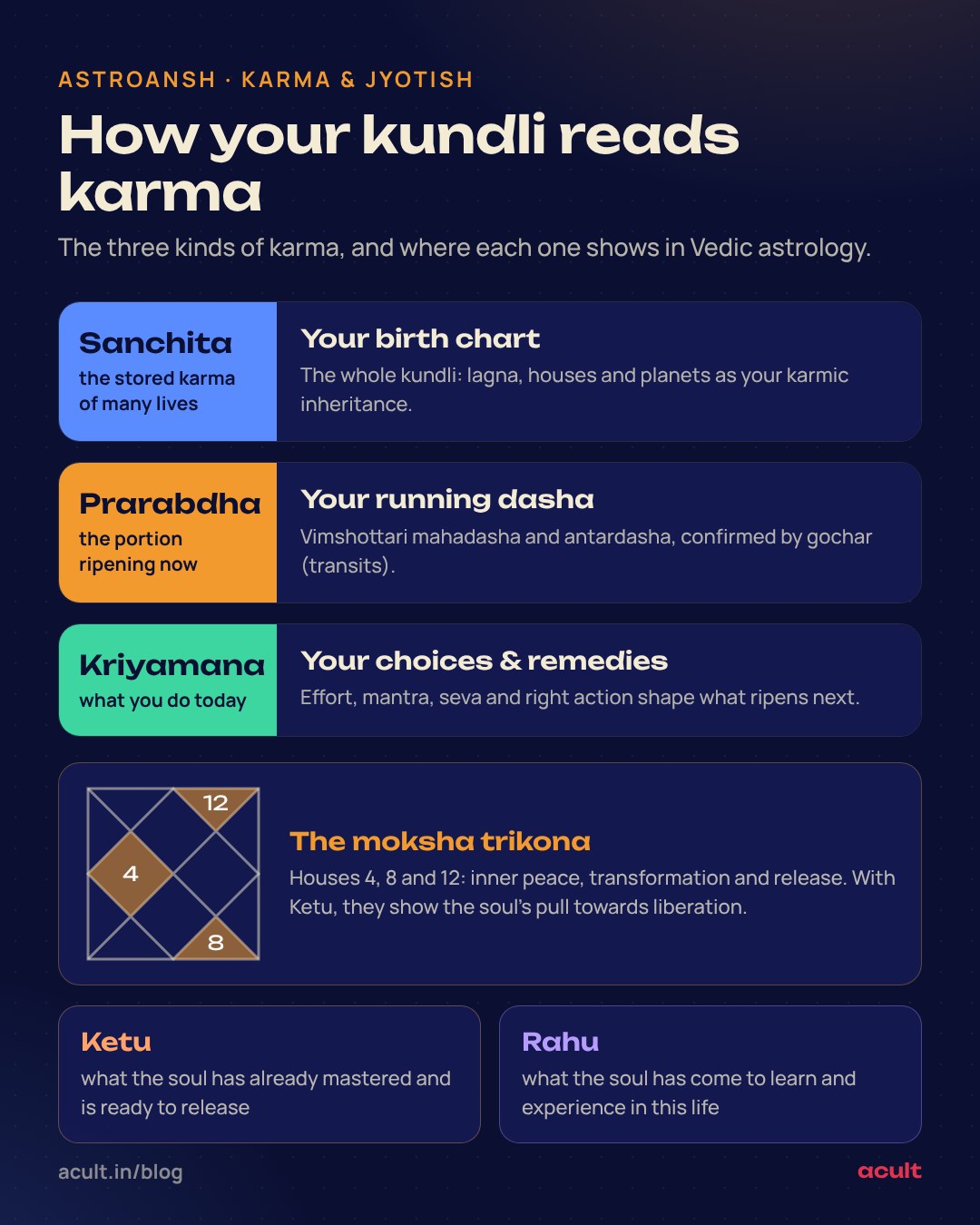
This is where philosophy becomes astrology. A kundli is a way of reading karma in time.
| Kind of karma | What it is | Where Jyotish reads it |
|---|---|---|
| Sanchita | your karmic inheritance | the whole birth chart: lagna, houses, planets and yogas |
| Prarabdha | the karma ripening now | the running Vimshottari dasha, confirmed by gochar (transits) |
| Kriyamana | your present action | not fixed in the chart: your effort, conduct, mantra and remedies |
This is why a good Jyotishi never says "your chart has decided your life". The birth chart shows the store; the dasha shows which part of it is ripening and when; and your present action shapes what ripens next. Read more in the Learn library on karma in Jyotish and karma in the shastras.
2. Atman: the self that does not die
If the fruits of karma must be received, someone must receive them, even after death. This is why the idea of karma made the idea of a lasting self necessary. Seven of the nine schools accept an eternal atman. The Bhagavad Gita describes it most memorably:
नैनं छिन्दन्ति शस्त्राणि नैनं दहति पावकः ।
न चैनं क्लेदयन्त्यापो न शोषयति मारुतः ॥
Nainaṁ chhindanti śhastrāṇi nainaṁ dahati pāvakaḥ
Na chainaṁ kledayantyāpo na śhoṣhayati mārutaḥ
Weapons cannot cut it, fire cannot burn it, water cannot wet it, and wind cannot dry it. (Bhagavad Gita 2.23)
The schools describe the self differently. Nyaya, Vaisheshika and Mimamsa hold that the self is not conscious by nature but becomes conscious in union with the mind and body. Sankhya and Advaita see the self as pure consciousness. The Buddha denied a permanent self altogether, teaching instead a stream of consciousness that continues from life to life, like a flame passed from one lamp to another: neither the same flame nor a different one.
There is also an important difference from the Semitic religions. In Judaism, Christianity and Islam the soul is created, and an all-powerful God can judge and even destroy it. In the Indian view the self is eternal: no power can destroy it.
In Jyotish, the Sun is the natural significator of the atman, and the planet with the highest degree in your chart, the atmakaraka, is read as the soul's own signature. See chara karakas in the Learn library.
3. Rebirth: the long journey
Every Indian school except Charvaka accepts punarjanma, rebirth. This is different from the Christian idea of resurrection, in which the same body is raised once, on the day of judgment. In the Indian view, the self passes through many bodies and many lives until its karma is exhausted.
Rebirth also appears outside India. Pythagoras taught it in ancient Greece; Giordano Bruno, burned in Rome in 1600 for his views, defended it; and Jewish mysticism has the idea of gilgul. In the twentieth century, the psychiatrist Dr. Ian Stevenson of the University of Virginia spent four decades documenting children who said they remembered past lives, publishing Twenty Cases Suggestive of Reincarnation. His work remains debated, but it shows that the question is still alive.
In a kundli, the lunar nodes describe this journey. Ketu marks what the soul has already mastered and is ready to release; Rahu marks what it has come to learn and experience in this life. Read about Rahu and Ketu.
4. Life involves suffering, and suffering can end
The Buddha's first noble truth is sarvam duhkham: life involves suffering. When challenged that life also contains pleasure, the tradition answers that pleasure itself carries three kinds of pain: the pain of getting it, the anxiety of keeping it, and the grief of losing it. Think of the effort of years spent preparing for an exam, the fear of losing a position once you have it, and the emptiness the day after retirement. Sankhya adds that suffering comes in three forms: from within ourselves (adhyatmika), from other beings (adhibhautika) and from forces beyond our control (adhidaivika).
This is why Indian philosophy is sometimes called pessimistic. That judgement is only half the picture. Pessimism is judged by where a philosophy ends, not where it begins. Indian thought begins with suffering and ends with a path out of it. The Buddha's fourth noble truth is the path; the Upanishads' last word is freedom. That is optimism with its eyes open.
5. Moksha: freedom from the cycle
In the Semitic religions, the highest goal is heaven, a return to the garden from which humanity fell. In India, heaven (svarga) is at best a temporary pleasant world, still inside the cycle. The real goal is moksha: release from karma and rebirth altogether.
The schools give it different names and descriptions:
| School | Name for liberation | How it is described |
|---|---|---|
| Buddhism | Nirvana | the end of craving and suffering |
| Jainism | Kaivalya | the soul alone, free of karmic matter |
| Nyaya | Apavarga | release from all pain |
| Mimamsa | Nihshreyasa | the highest good |
| Vedanta | Moksha / Mukti | realisation of Brahman, or eternal union with God |
Unlike any worldly achievement, moksha is permanent. There is no probation period and no second exam: once free, always free.
In a birth chart, the 4th, 8th and 12th houses form the moksha trikona, the triangle of liberation: inner peace, transformation and release. Together with Ketu and the 12th house in particular, they show the soul's pull towards freedom. Explore the meaning of every house in the twelve bhavas.
Is the world real?
One more shared belief is often overlooked: most Indian schools treat the world as real. Only a few disagree. Advaita Vedanta calls it mithya, and two Mahayana schools, Nagarjuna's Madhyamaka (Shunyavada) and the Yogachara of the brothers Asanga and Vasubandhu, who taught at Nalanda, treat it as appearance rather than ultimate reality.
The others describe the world as made of the five great elements, the pancha mahabhuta: earth, water, fire, air and space (kshiti, jal, pavak, gagan, sameer). Charvaka accepts only four, rejecting space because it cannot be perceived. These same five elements reappear in Jyotish, where every sign and planet is linked to an element.
Religion and philosophy walk together in India
In the West, philosophy and religion have often been in tension. Socrates was condemned partly for "impiety"; Bruno was executed by religious authority. In India, almost every darshan is tied to a living spiritual tradition: the Shad Darshana to Hinduism, the Jain and Bauddha darshanas to their own paths, and Sikh thought to Sikhism.
The reason is simple. In India, the purpose of philosophy was always practical: to free a person from suffering. It was never only a debate in a lecture hall. That is also why darshan and Jyotish belong together. Astrology, rightly understood, is applied philosophy: a way of seeing your karma clearly so that you can act wisely.
Free will or destiny?
The deepest question in philosophy takes a very practical form for anyone who has had their chart read: if it is written in my kundli, can I change it?
Philosophers call this the debate between determinism (niyativada) and free will (sankalp svatantrya). Pure logic often seems to favour determinism. The German philosopher Schopenhauer, a famous pessimist, observed that a person can do what they will, but cannot will what they will; Albert Einstein liked to quote him. Yet no society can work without some idea of free will. Without it, nobody could be praised for a good act or held responsible for a crime.
The Jyotish answer is both, held in balance. Prarabdha has already begun and must be lived through. Kriyamana, what you do now, is in your hands, and it shapes what ripens next. You may not choose the season, but you can choose how you walk through it. That is exactly why astrology speaks of remedies: not as magic, but as conscious action in a known season.
Key terms of Indian philosophy
| Term | Meaning |
|---|---|
| Darshan | a "way of seeing"; a school of philosophy |
| Astika / Nastika | schools that accept / do not accept the Vedas as a source of knowledge |
| Shad Darshana | the six astika schools |
| Pramana | a valid means of knowledge, such as perception, inference or testimony |
| Atman | the self |
| Brahman | the one ultimate reality |
| Mithya | neither simply real nor simply unreal (Advaita) |
| Prakriti / Purusha | nature and consciousness (Sankhya) |
| Guna | the three qualities of nature: sattva, rajas, tamas |
| Sanchita / Prarabdha / Kriyamana | stored, ripening and present karma |
| Punarjanma | rebirth |
| Moksha | liberation from the cycle of birth and death |
| Sutra / Bhashya | a concise aphorism / a commentary on it |
| Prasthana Trayi | the Upanishads, the Gita and the Brahma Sutras |
How acult by AstroAnsh helps you live this philosophy
In India, philosophy was never meant to stay on the page. At AstroAnsh, Jyotish is taught as a living part of this tradition, and acult puts that practice in your hands:
- Your living kundli. Your chart drawn on your Home screen, every planet and house explained for you, with the grahas running your current dasha highlighted. This is your sanchita made visible.
- Your whole life in dashas. Your Vimshottari periods from birth onwards, with what the current period brings to career, money, health and relationships. This is your prarabdha, in time.
- Today's sky and what is coming. Where today's planets move through your houses, and the sign changes ahead, so that you can prepare rather than react.
- Panchang and Vrat & Festivals. Tithi, nakshatra, Rahu Kaal and every fast and festival of the year, so that daily life keeps time with the cosmos.
- Mantra Counter. Count your japa with a pinch of your fingers in front of the camera, by voice or by tap, towards a 108-bead mala, with your history saved.
- Remedy Classes. Two live classes on choosing and performing remedies correctly, with notes, lifetime recordings and Margadarshika, our mantra remedies book. This is your kriyamana, done with understanding.
- Learn Jyotish. A structured library that explains karma, the grahas, the houses, the nakshatras and the dashas step by step.
- Personal guidance. When a question needs a person, not a screen.
Frequently asked questions
What is Indian philosophy in simple words? Indian philosophy, or Bharatiya Darshan, is the set of systems of thought that grew in India from the Vedic age onwards, asking what the self is, what reality is, how we can know anything, and how a person can be free from suffering. Unlike much Western philosophy, it was always meant to be lived, not only debated.
What are the six schools of Indian philosophy? The six astika schools, together called the Shad Darshana, are Sankhya, Yoga, Nyaya, Vaisheshika, Mimamsa and Vedanta. They work in three pairs: Sankhya and Yoga, Nyaya and Vaisheshika, and Mimamsa and Vedanta.
What is the difference between astika and nastika? In Indian philosophy, an astika school accepts the Vedas as a valid source of knowledge and a nastika school does not. It is not the same as believing or not believing in God: classical Sankhya is astika without centring on a creator God, while Jainism and Buddhism are nastika.
What are the three types of karma? Sanchita karma is the total store of past karma; prarabdha karma is the portion ripening in this life; and kriyamana (or agami) karma is the karma being created now through present actions.
How is karma related to Vedic astrology? Vedic astrology reads sanchita karma in the birth chart as a whole, prarabdha karma in the running Vimshottari dasha confirmed by transits, and leaves kriyamana karma to the person's present choices and remedies. A kundli shows which karma is ripening and when, not a fixed fate.
Which Indian philosophy does not believe in karma or rebirth? Charvaka, also called Lokayata, is the only classical Indian school that rejects karma, rebirth, the soul beyond the body and moksha. It accepts only direct perception as valid knowledge.
Does Buddhism believe in the soul? No. The Buddha taught anatta, that there is no permanent self. Buddhism still accepts karma and rebirth, explained as a stream of consciousness continuing from life to life, like a flame passed from one lamp to another.
What is the difference between moksha and heaven? Heaven (svarga) in Indian thought is a temporary pleasant world that is still inside the cycle of birth and death. Moksha is permanent liberation from that cycle altogether. In the Semitic religions, by contrast, heaven is the final goal.
Which houses show moksha in a kundli? The 4th, 8th and 12th houses form the moksha trikona, the triangle of liberation. Ketu, the 12th house and the atmakaraka are also studied for the soul's spiritual direction.
Which books should I read to start learning Indian philosophy? Two dependable introductions are Bharatiya Darshan ki Rooprekha by Prof. Harendra Prasad Sinha (in Hindi) and A Critical Survey of Indian Philosophy by Chandradhar Sharma (in English), both published by Motilal Banarsidass. The writings of Swami Vivekananda are an excellent doorway into Vedanta.
Where this series goes next
This was the map. In the coming posts we will walk each road in turn, beginning with the boldest school of all, Charvaka, and then Jainism, Buddhism, Sankhya and Yoga, Nyaya and Vaisheshika, Mimamsa and finally Vedanta. With each one, we will ask the same question: what does this way of seeing teach us about reading a life, and a kundli, more wisely?
AstroAnsh
Everything on this page, worked out for your birth details, in seconds.
Keep reading
Chetna & the Gift of Human Birth
Why is a human birth called rare among 84 lakh yonis? Discover what chetna means, why the human yoni is a karma yoni, and how your kundli maps the soul's journey.
Gochar: How Transits Confirm Events
Dasha shows the chapter; gochar confirms the timing. Learn how double transit, Ashtakavarga and Sade Sati confirm events, and the best software to check them.